
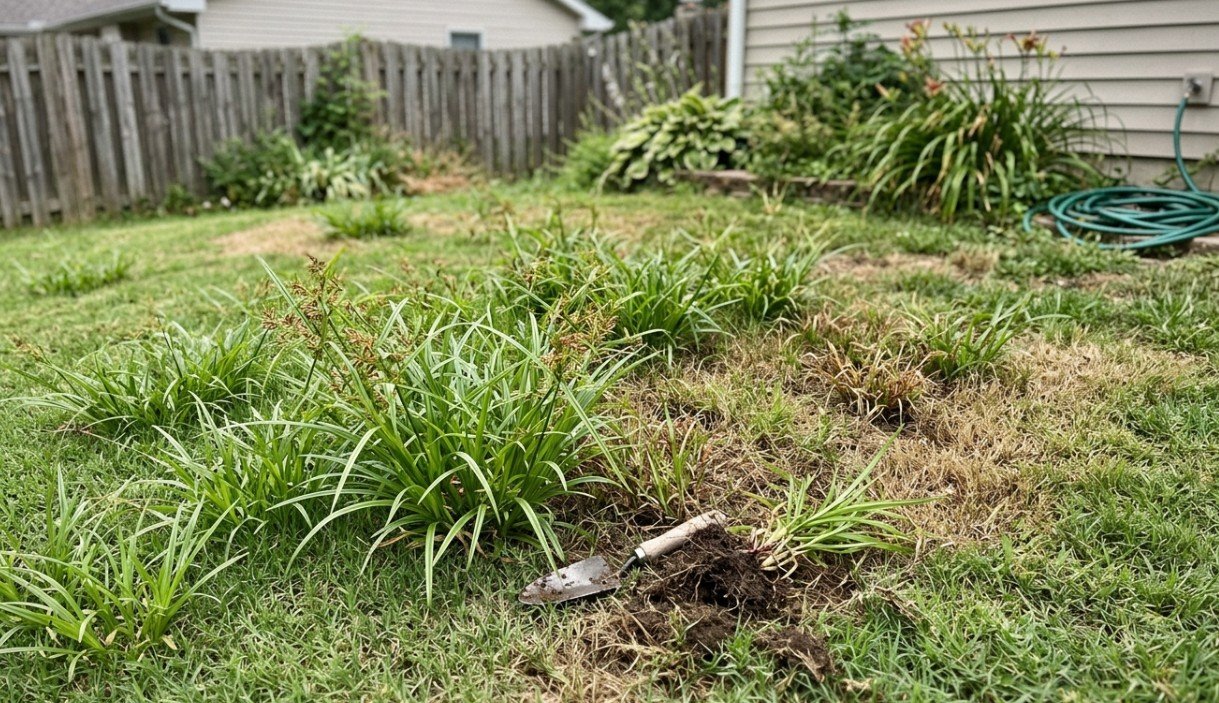
Key takeaway: Nutgrass (Cyperus rotundus) is a sedge, not a true grass, and it keeps coming back because pulling the visible shoot leaves an underground chain of tubers behind, tubers that can survive in soil for three to five years and up to ten under ideal conditions. The only things that actually work are repeated treatment with a herbicide containing halosulfuron-methyl, currently the standard turf-registered active for nutgrass in Australian lawns, or glyphosate timed precisely to the flowering stage in non-turf areas. Either way, one treatment is never the end of it.
If you’ve sprayed or pulled the same patch of nutgrass three summers running and it’s still there, you haven’t failed at weeding. You’ve been fighting the wrong part of the plant. Everything above the soil on a nutgrass plant is almost incidental to how it survives; the real plant is a chain of underground tubers, and until those are dealt with, the leaves you see are just the part that grows back. If bindii, clover or other broadleaf weeds are the bigger issue in your lawn instead, our guide to getting rid of bindii and clover covers that separately, since the products and timing are completely different. The same underground-survival trick applies to oxalis and soursob, another lawn weed that laughs off hand-pulling, and to onion weed [INTERNAL LINK OPPORTUNITY: link to “Onion Weed: Why Mowing Makes It Worse”, draft 1284, not yet published], where disturbing the bulb is what spreads it rather than mowing itself.
What Nutgrass Actually Is
Nutgrass is the common name for Cyperus rotundus, and despite the name, it’s a sedge rather than a true grass. The old field trick still works: sedges have edges, and it’s exactly why nutgrass doesn’t belong on our wider list of actual types of grass in Australia. Nutgrass stems are erect, unbranched and distinctly triangular in cross-section, where a true lawn grass stem is round. The leaves are dark to bright green, glossy and 2 to 6mm wide, and the plant usually reaches 20 to 50cm before it’s mown or pulled back down.
The part that matters for control is underground. Nutgrass spreads through a connected network of small, dark, oval tubers, commonly called nuts, joined by white rhizomes. A nutgrass fact sheet produced through the University of New England’s weed management research is explicit that these tubers can persist in soil for three to five years, and as long as ten years under ideal conditions. In Australia, the above-ground seed head is sterile, so every new patch is grown from a tuber or a rhizome fragment, not from seed blown in on the wind.
Why It Keeps Coming Back
Pull a nutgrass shoot and you take the leaf and maybe the tuber it grew from, but rarely the whole chain. Every tuber left behind is a fresh plant waiting for the right conditions. The same research notes that dormancy in the tubers is broken by soil temperatures of roughly 33 to 37°C, which is exactly why new shoots seem to erupt overnight through a hot spell in late spring and summer. Nutgrass is a warm, wet-soil specialist: it thrives under tropical and subtropical conditions and is genuinely invasive where soil stays moist through summer, but it does not survive extended dry conditions, which is one of the few practical weaknesses a home gardener can actually use against it.
What Actually Kills It
Realistic control means accepting this is a multi-season project against a tuber bank, not a one-spray fix.
In an Established Lawn
A herbicide containing halosulfuron-methyl is the standard turf-safe option, registered by the APVMA for nutgrass control across common Australian lawn grasses, and it’s a systemic product with the same one-to-three-week timeline covered in our guide to how long weed killer takes to work. It works best applied before the plant reaches around five leaves, and it’s sold under several different brand names rather than one fixed product, so always check the current label on the container you’re holding for the exact rate and which grass types it’s safe on, and confirm through APVMA PubCRIS that the specific product is still currently registered before you buy. This is the one genuinely selective option: it targets the sedge without taking the lawn with it, which is not true of the next option. Our seasonal guide to weeding and feeding your lawn covers how to fit a targeted weed treatment like this into a broader year-round program rather than treating it as a one-off.
In Garden Beds and Non-Turf Areas
Glyphosate is a genuine option outside the lawn itself, but the timing is unforgiving. It only works if applied once at least 20% of the nutgrass is flowering, at a sufficiently high rate, since spraying earlier only burns the leaves and leaves the tuber chain fully able to resprout. A second application 6 to 8 weeks later is standard practice. Because glyphosate is non-selective, it will damage or kill any lawn grass it lands on too, so it belongs in a garden bed, a path or a full renovation, never as a spot spray inside an established lawn you want to keep.
Without Chemicals
Hand weeding only genuinely works on a small, isolated patch, and it means digging out the connected tuber chain, not just the leaf. Mark the spot and keep checking it, since a single missed tuber restarts the patch. Where soil can be cultivated, exposing tubers to a hot, dry surface lets them dehydrate and lose viability, though this suits a garden bed being reworked far better than an established lawn. A thick, well-fed, correctly mown lawn also competes better against new nutgrass shoots, though density alone won’t clear a patch that’s already established.
Nutgrass Look-Alikes
Mullumbimby couch is a related sedge weed, often controlled with the same halosulfuron-based products, but it’s a different plant from nutgrass. See our full side-by-side comparison [INTERNAL LINK OPPORTUNITY: link to “Mullumbimby Couch vs Nutgrass: How to Tell Them Apart”, draft 1392, not yet published] to tell them apart. If you’ve ruled out nutgrass on the triangular-stem test but the patch is still clearly not lawn grass, that’s the more likely candidate. True lawn grasses, including couch and kikuyu runners that have gone rogue into a garden bed, always have a round, not triangular, stem, which is the fastest way to rule grass invasion out before reaching for a sedge-specific product.
Common Mistakes
- Pulling it and expecting it gone. Unless every connected tuber comes out with it, the patch will be back within weeks.
- Spraying glyphosate straight into the lawn. It isn’t selective. It will damage the grass along with the nutgrass.
- Spraying glyphosate before flowering. Too early and it only kills the leaves, leaving the tuber bank untouched and ready to resprout.
- Treating once and stopping. With tubers viable for years in the soil, repeat treatment across more than one season is the realistic expectation, not a sign something went wrong.
- Ignoring a small patch. A single isolated clump is the easiest point to eradicate it. Left alone, it builds an underground tuber network that gets harder to clear every season.
See our guide to lawn weeds in Australia [INTERNAL LINK OPPORTUNITY: link to “Lawn Weeds in Australia: The Complete Guide”, draft 1343, not yet published] for how this fits with every other weed on an Australian lawn.
Frequently Asked Questions
What kills nutgrass permanently?
Nothing in a single treatment. Realistic control means repeated applications, either a halosulfuron-methyl herbicide in turf or glyphosate timed to flowering in non-turf areas, across more than one season until the underground tuber bank is exhausted.
Does Roundup (glyphosate) kill nutgrass?
Only if applied once at least 20% of the plants are flowering, at a sufficiently high rate, with a second application 6 to 8 weeks later. Sprayed earlier, it only burns the leaves and the tubers resprout. It will also damage any lawn grass it touches, so it’s not a lawn spot-spray option.
Why does nutgrass keep coming back in the same spot every year?
Because the plant survives as a chain of underground tubers that can persist in soil for three to five years, and up to ten under ideal conditions. Removing the visible leaf without removing the connected tubers leaves the plant fully able to regrow.
What is nutgrass?
Nutgrass (Cyperus rotundus) is a perennial sedge, not a true grass, identifiable by its triangular stem and its spread through underground tubers rather than seed.
Is nutgrass a declared weed in Australia?
It’s listed as a weed of concern in some states, such as South Australia’s PIRSA weed profiles, with legal requirements that vary by region. There’s no single uniform national declaration, so check your own state agriculture department or local landscape board for what applies where you are.
Is Mullumbimby couch the same as nutgrass?
No, though the two are often confused and are typically controlled with the same halosulfuron-based herbicides. Mullumbimby couch is a related but distinct sedge weed.
Sources
- Soil Wealth and Integrated Crop Protection (Hort Innovation), Integrated Weed Management Fact Sheet: Nutgrass, drawing on University of New England weed management research
- Government of South Australia, Primary Industries and Regions SA (PIRSA), Nutgrass weed profile
- APVMA, Search Registered Chemical Products and Permits (PubCRIS)
