
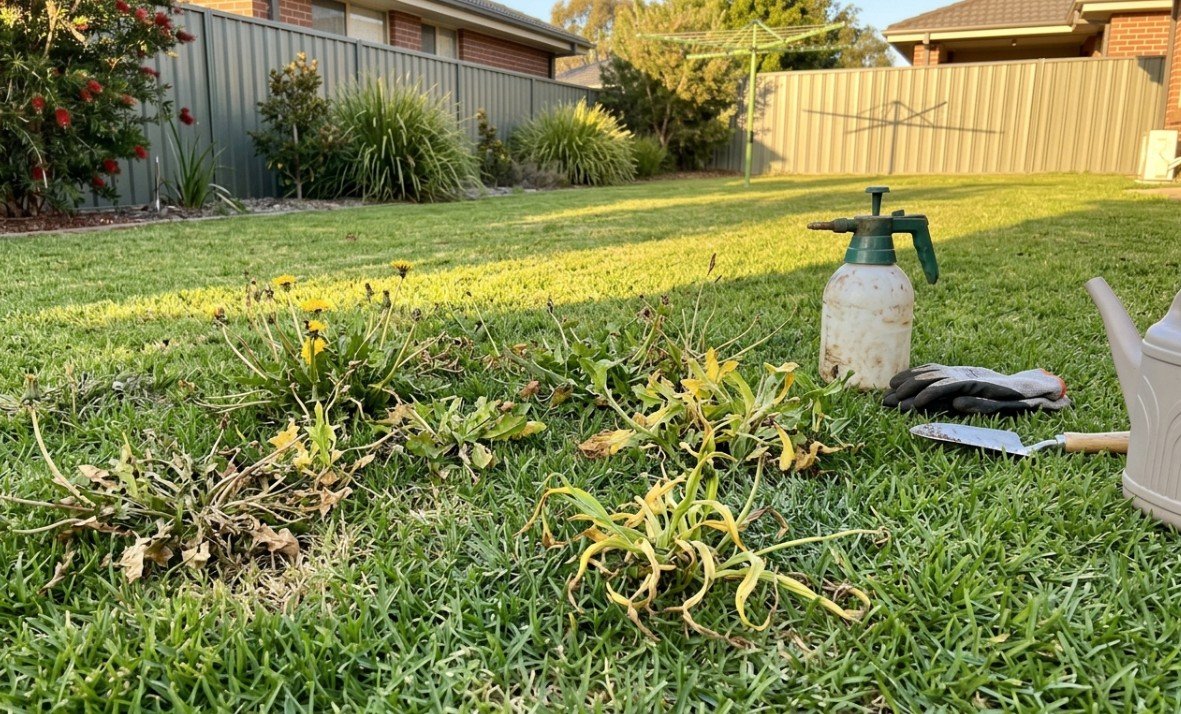
Key takeaway: How long a weed killer takes depends entirely on what type it is, not how strong it smells or how much you used. A contact herbicide burns visible leaf tissue within a day or two but often leaves the root alive. A systemic, translocated herbicide, glyphosate or a selective broadleaf product, usually takes one to three weeks to fully kill a weed as it’s absorbed and carried down to the root. A pre-emergent herbicide never produces a visible kill at all, since its entire job is stopping the next generation of weeds from germinating in the first place. If nothing’s happened after a day, that’s often the product working exactly as designed, not a failure.
“How long until it’s dead” is really three different questions wearing one disguise, because not every weed killer works the same way or on the same timeline. Knowing which type is in your hand before you judge whether it’s working saves a lot of premature re-spraying.
It Depends What Kind of Herbicide You’re Using
- Contact herbicides kill only the leaf tissue they physically touch, and do it fast, often visible within hours to a couple of days. The trade-off is that a perennial weed with a root system or underground storage organ frequently survives and regrows, since the chemical never reached below the leaf surface.
- Systemic (translocated) herbicides, glyphosate being the classic example, are absorbed through the leaf and carried down into the root system before the plant dies. That’s slower to show, typically several days to two weeks, but it’s a genuinely more complete kill on a perennial weed because the root dies along with the leaf.
- Selective broadleaf herbicides, the bindii and clover type products built on 2,4-D, MCPP or dicamba, are also systemic, and work on the same rough one-to-three-week timeline. Our guide to getting rid of bindii and clover covers choosing the right one for your grass type.
- Pre-emergent herbicides don’t kill anything you can see, because they’re applied before weed seeds germinate, forming a barrier in the topsoil that stops seedlings emerging at all. Judging a pre-emergent by “is anything dying” misunderstands the product; the real question is whether the weed you were expecting simply never showed up.
Selective versus non-selective is the other axis that matters. A selective herbicide is built to leave your lawn grass alone while killing a broadleaf weed growing in it. A non-selective one, glyphosate again being the standard example, kills whatever green tissue it lands on, lawn grass included, which is exactly why it’s the tool for clearing an entire area rather than weeding within a lawn you want to keep. Our guide to killing grass before renovating a lawn covers that whole-area use in full.
Why It Might Look Like It’s Not Working
- The weed wasn’t actively growing. A dormant, stressed or drought-affected weed takes up far less herbicide than one growing vigorously, so timing your spray to active growth genuinely matters.
- Rain washed it off before it was absorbed. Most systemic herbicides need a dry window, often several hours at minimum, to be taken up before rain undoes the application. Check your specific label for the exact figure.
- It’s a perennial weed with underground storage. Nutgrass tubers and soursob bulbs are the extreme version of this: a single application rarely reaches every connected tuber or bulb, so regrowth after an apparently successful spray is normal, not a sign of failure. Our guides to nutgrass and oxalis and soursob cover why those two in particular need repeat treatment.
- Wrong product for the weed. A contact product applied to a rhizome or bulb-forming perennial burns the leaf and stops there.
Mowing and Watering Around a Spray
Don’t mow immediately before spraying a systemic herbicide; the weed needs leaf surface to absorb it from. Give it time to translocate afterwards too, generally a matter of days rather than hours, before the next mow, since cutting the leaf off too soon removes the pathway the chemical is still using to reach the root. Exact timing varies by product, so this is a label question, not a rule of thumb to apply blindly.
Does DIY Weed Killer Work as Well?
Homemade vinegar or salt-based sprays act as a contact burn, fast on the visible leaf, but they carry the same limitation as any contact product: they rarely reach the root of an established perennial weed. Our guide to killing grass before renovating covers why vinegar, salt and bleach in particular aren’t the shortcut they’re made out to be, including what salt in particular does to soil you might want to plant into again.
Common Mistakes
- Judging a systemic herbicide a failure after only a day or two. One to three weeks is the normal window, not an instant result.
- Expecting to see something die from a pre-emergent. Success looks like nothing new germinating, not a visible kill.
- Re-spraying too soon. A second application before the first has had time to work wastes product and risks over-application.
- Mowing or watering right after spraying. Both can interrupt uptake before the herbicide has been absorbed.
- Using a contact or DIY product on a perennial, rhizome or bulb weed. Expect regrowth, since the root was never reached.
See our full guide to lawn weeds in Australia [INTERNAL LINK OPPORTUNITY: link to “Lawn Weeds in Australia: The Complete Guide”, draft 1343, not yet published] for how this fits with every other weed on an Australian lawn.
Frequently Asked Questions
How long does weed killer take to work?
It depends on the type. A contact herbicide shows visible burn within hours to a couple of days but often leaves the root alive. A systemic herbicide such as glyphosate or a selective broadleaf product usually takes one to three weeks for a complete kill. A pre-emergent herbicide never produces a visible kill at all, since it prevents germination rather than killing an existing plant.
How long does glyphosate take to kill weeds?
Typically a few days for visible yellowing to appear, with a complete kill usually within one to two weeks on actively growing plants. A rhizome-heavy perennial may need a second application on regrowth.
Does weed killer kill grass too?
It depends whether it’s selective or non-selective. A selective herbicide is built to leave lawn grass alone while killing a broadleaf weed growing in it. A non-selective herbicide such as glyphosate kills whatever green tissue it touches, lawn grass included.
Why is my weed killer not working?
Common reasons include spraying a dormant or stressed weed that isn’t actively taking up the chemical, rain washing off the application before it was absorbed, using a contact product on a perennial weed with an underground root, tuber or bulb, or simply not having waited long enough for a systemic product to finish working.
How soon can I mow after spraying weed killer?
Generally several days rather than hours, since mowing too soon removes the leaf surface a systemic herbicide is still using to reach the root. Check the specific product label for the exact recommended interval.
Does homemade or DIY weed killer work as well as a registered herbicide?
It acts as a fast contact burn on the visible leaf, similar to a commercial contact product, but it rarely kills the root of an established perennial weed, so regrowth is common.
