
Key takeaway: Munns Professional Buffalo Booster is a granular 16.5-0.3-9 lawn fertiliser applied at about 22 g/m² every 8 to 12 weeks, which delivers roughly 3.6 g of nitrogen per square metre per feed. That sits just under the 4 g/m² single-application ceiling in WA’s turf guidelines, so the label rate is sound, as long as you don’t overload a patch or spread it above 30°C.
This Munns Buffalo Booster review is research-based. We read the official product page, the safety data sheet and 80 buyer ratings, then checked the label rate against independent nitrogen guidelines for buffalo. Standing in the fertiliser aisle in September, wondering if it suits your Sir Walter? Here’s the short answer. The formula is sensible, the rate is safe, and the main complaints are about what’s in the bag and how it’s spread.
First, Which Buffalo Booster Are We Talking About?
Two different Munns products share the name, and retail listings mix them up constantly.
| Buffalo Booster Lawn Fertiliser | Buffalo Booster Weed & Feed | |
|---|---|---|
| What it is | Straight fertiliser, no herbicide | Fertiliser plus iron (ferrous) sulfate for weeds |
| Analysis | N 16.5%, P 0.3%, K 9% | N 5%, iron 5%, sulfur 8.5%, no P or K |
| Rate | About 22 g/m² | 67 g/m² |
| Pack sizes | 5 kg (about 220 m²) and 10 kg (about 440 m²) | 5 kg (about 75 m²) |
| Poison schedule | Not applicable | S5 (Caution) |
| Buyer rating | 4.0/5 from 80 ratings | 2.6/5 from 18 ratings |
This review is about the fertiliser. The Weed & Feed version is a separate product whose weed action comes from iron sulfate, which blackens soft broadleaf weeds but often doesn’t finish them off. That alone explains most of its one-star reviews. Munns Professional is now a Yates brand (part of DuluxGroup), and it has no connection to Paul Munns Instant Lawn, the South Australian turf farm.
What’s in Munns Buffalo Booster
The bag is black, low-odour granules. The NPK on the label is 16.5-0.3-9: nitrogen for leaf growth and colour, almost no phosphorus, and a fairly high 9% potassium. Most buffalo fertilisers run 4 to 6% potassium, so this one leans harder on the nutrient linked to drought and wear tolerance. Munns also claims more than 10 nutrients and trace elements, organic ingredients and a natural wetting agent, but none of those extras are itemised on the page or in the safety data sheet. There’s no slow-release claim either.
If NPK numbers are new to you, our explainer on what NPK means on a fertiliser bag walks through each one.
The Label Rate in Real Nitrogen Terms
Here’s the sum nobody else shows. Nitrogen is what greens a lawn and also what burns it, so it’s worth knowing how much you’re actually putting down.
| Working | Result |
|---|---|
| 22 g/m² × 16.5% nitrogen | 3.63 g N/m² per feed (36.3 kg N/ha) |
| 22 g/m² × 9% potassium | 1.98 g K/m² per feed |
| 3 to 4 feeds a year | 10.9 to 14.5 g N/m² a year (109 to 145 kg N/ha) |
| Half rate on sandy soil (about 11 g/m²) | About 1.8 g N/m² every 4 to 6 weeks |
| 5 kg bag ÷ 22 g/m² | About 227 m², matching the 220 m² on the bag |
Now compare. The WA turf and grassed areas guidelines cap any single nitrogen application at 40 kg/ha, which is 4 g/m², and suggest 100 to 200 kg N/ha a year for high-use turf. A federal gene technology regulator report on buffalo grass cites research putting Sir Walter’s optimum at around 200 kg N/ha a year for acceptable colour. So the Buffalo Booster programme sits inside both benchmarks. It isn’t overkill.
The catch is the margin. At 30 g/m² instead of 22, you’re at about 5 g N/m², over the WA single-dose cap. A heavy handful, a double pass, or a spill near the bag is exactly how burnt stripes happen.
How to Apply Buffalo Booster Properly
- Check the forecast. Don’t apply when the maximum is over 30°C, when the soil is dry, or when the lawn is moisture stressed.
- Make sure paths, driveways and pavers are dry first. The label warns the product can stain.
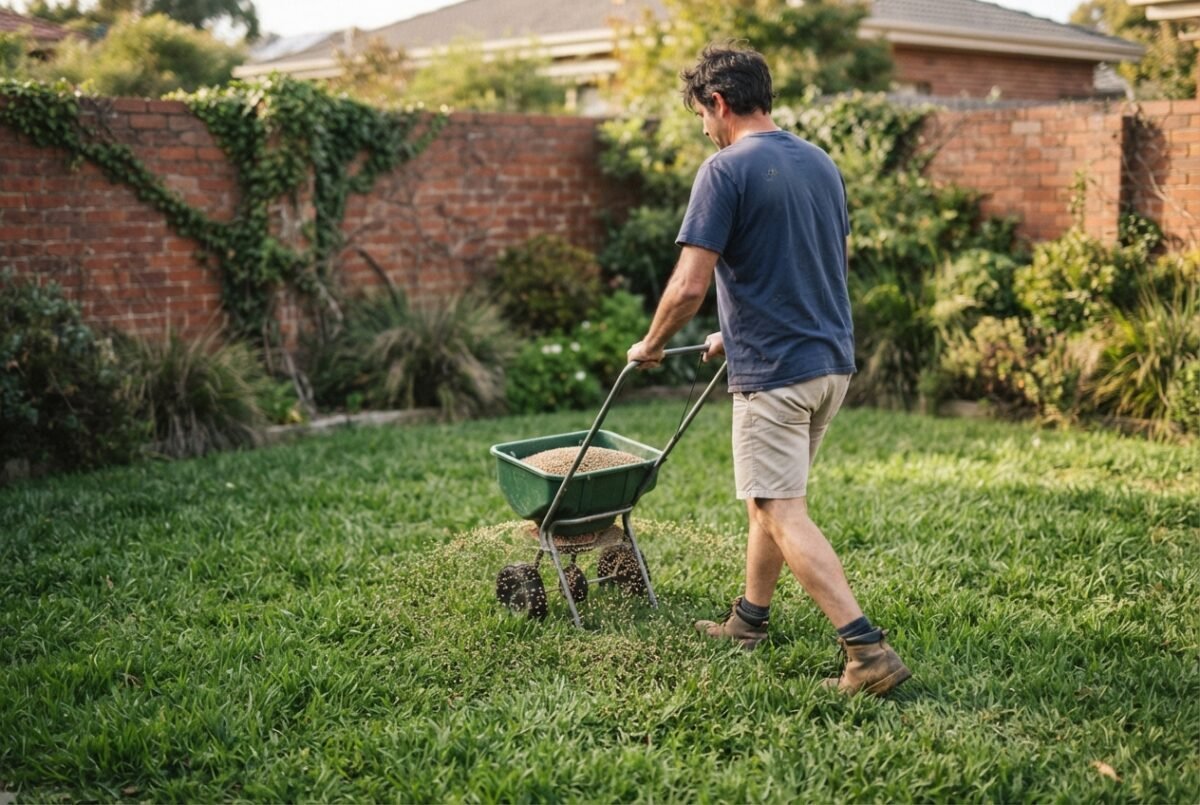
- Measure your lawn and weigh out the dose. A 60 m² backyard needs about 1.3 kg. A third of an adult handful is roughly 22 g, though a spreader is more even.
- Spread in a sweeping arc, or with a spreader in two half-rate passes at right angles. Avoid windy days.
- Sweep any granules off hard surfaces, then water in well straight away.
- Repeat every 8 to 12 weeks through the growing season, for three or four feeds a year.
When to Feed a Buffalo Lawn
The page says Buffalo Booster can go on any time of year but works best in early spring, summer and autumn. That fits how buffalo grows. It greens up in spring, peaks in summer, slows in autumn and goes dormant over winter in temperate and cool zones. The OGTR report notes that putting a good share of the year’s nitrogen on in early spring trims the summer growth surge, which means less mowing.
In practice that’s September, a summer feed in December or January, and a last feed in March or April for Sydney, Melbourne, Adelaide and Perth. Brisbane and the subtropics can stretch the season either side. Skip winter feeds in the south, when uptake is low and rain can wash nitrogen through sandy soil. Our guide to when to fertilise your lawn covers timing in more detail.
What 80 Buyers Say
Buffalo Booster’s retailer listing averaged 4.0 out of 5 from 80 ratings when we read it on 15 October 2026 (48 five-star, 14 one-star). The trend over time matters more than the average.
- 2020 to early 2023: almost every written review is four or five stars. Long-term Sir Walter owners report a darker lawn within two to three weeks and results that hold rather than flash and fade.
- Late 2023 onward: 10 of the 16 written reviews are one star. The most common complaint, in six reviews, is that the bag looks mostly sand or dirt.
- Clumping: several buyers say damp product wouldn’t flow through a spreader.
- Burn: a handful report burnt patches. At least one applied it to turf laid four weeks earlier, which the label rules out for lawns under 12 weeks old.
A fair reading of the sand complaints: the granules are meant to be black and contain organic material, so some of what looks like dirt may be the carrier. We can’t verify what was in any individual bag. Still, a run of similar reports from different buyers is worth knowing about. Open the bag before you start and check it flows.
No buyers mentioned smell, and none mentioned staining, though the label itself warns about it.
Can You Over-Fertilise a Buffalo Lawn?
Yes. Too much nitrogen at once scorches the leaf, especially in heat or on dry soil. Repeated heavy feeding also drives soft, lush growth, and buffalo is already prone to building thatch, which the OGTR report says needs regular renovation. More fertiliser doesn’t fix a pale lawn either. On alkaline soils, yellowing in buffalo is often an iron or manganese shortage, not a nitrogen one.
Stay at or under the label rate, water in, and if the lawn stays pale, test the soil pH before adding more. Our guide to choosing a lawn fertiliser covers which products suit which grass.
How It Compares
| Product | NPK | Label rate | N per feed (derived) | Release |
|---|---|---|---|---|
| Munns Buffalo Booster | 16.5-0.3-9 | 22 g/m² | 3.6 g/m² | Not claimed |
| Scotts Lawn Builder Buffalo | 28-0.5-6 | 16 g/m² | 4.5 g/m² | Up to 3 months |
| Lawn Solutions Premium | 16-0.7-4 + iron, sulfur | 20 to 25 g/m² | 3.2 to 4.0 g/m² | Up to 12 weeks |
Buffalo Booster’s edge is the high potassium and a gentler nitrogen dose than the Scotts product. Its weak spots are no slow-release claim, so it needs watering in promptly, and the recent quality complaints.
Our Verdict
On paper, Munns Buffalo Booster is a well-pitched buffalo fertiliser. The label rate lands inside independent nitrogen guidelines, the potassium is generous, and years of Sir Walter owners rate it. The recent run of one-star reviews about bag contents and clumping is the reason for caution, not the formula. Weigh your dose, spread it in two passes, water in straight away, and check a fresh bag before you commit to the whole lawn.
Frequently Asked Questions
Is Munns Buffalo Booster good for Sir Walter buffalo?
Yes. It’s formulated for buffalo lawns, and long-term Sir Walter owners make up much of its positive reviews. At the label rate of about 22 g/m² it supplies around 3.6 g of nitrogen per square metre, within independent guidelines.
How often should I apply Munns Buffalo Booster?
Every 8 to 12 weeks through the growing season, for three to four applications a year. On sandy soils or stressed lawns, the label says to apply half the rate twice as often, every 4 to 6 weeks.
Does Munns Buffalo Booster kill weeds?
No. The fertiliser has no herbicide. The separate Buffalo Booster Weed & Feed contains iron sulfate, which mainly blackens soft broadleaf weeds and draws many complaints that it doesn’t kill them.
Can Buffalo Booster burn my lawn?
It can if you overdose, spread it above 30°C, apply it to dry or stressed turf, or skip watering in. Lawns younger than 12 weeks shouldn’t be fed with it at all.
Will Munns Buffalo Booster stain concrete?
It can. The label says to make sure hard surfaces are dry before spreading, and to sweep stray granules back onto the lawn before watering in.
Sources
- Yates: Munns Professional Buffalo Booster Lawn Fertiliser product page (checked 15 October 2026)
- DuluxGroup: Munns Professional Buffalo Booster Lawn Fertiliser Safety Data Sheet, issued 14 February 2023 (checked 15 October 2026)
- Yates: Munns Professional Buffalo Booster Weed & Feed product page (checked 15 October 2026)
- Bunnings: Munns Professional Buffalo Booster Lawn Fertiliser, customer reviews (checked 15 October 2026)
- Bunnings: Munns Professional Buffalo Booster Weed N Feed, customer reviews (checked 15 October 2026)
- WA Department of Biodiversity, Conservation and Attractions: Environmental guidelines for the establishment and maintenance of turf and grassed areas (checked 15 October 2026)
- Office of the Gene Technology Regulator: The biology of Stenotaphrum secundatum (buffalo grass) (checked 15 October 2026)
- Scotts: Lawn Builder Buffalo Slow Release Lawn Fertiliser product page (checked 15 October 2026)
- Lawn Solutions Australia: Premium Fertiliser product page (checked 15 October 2026)
