
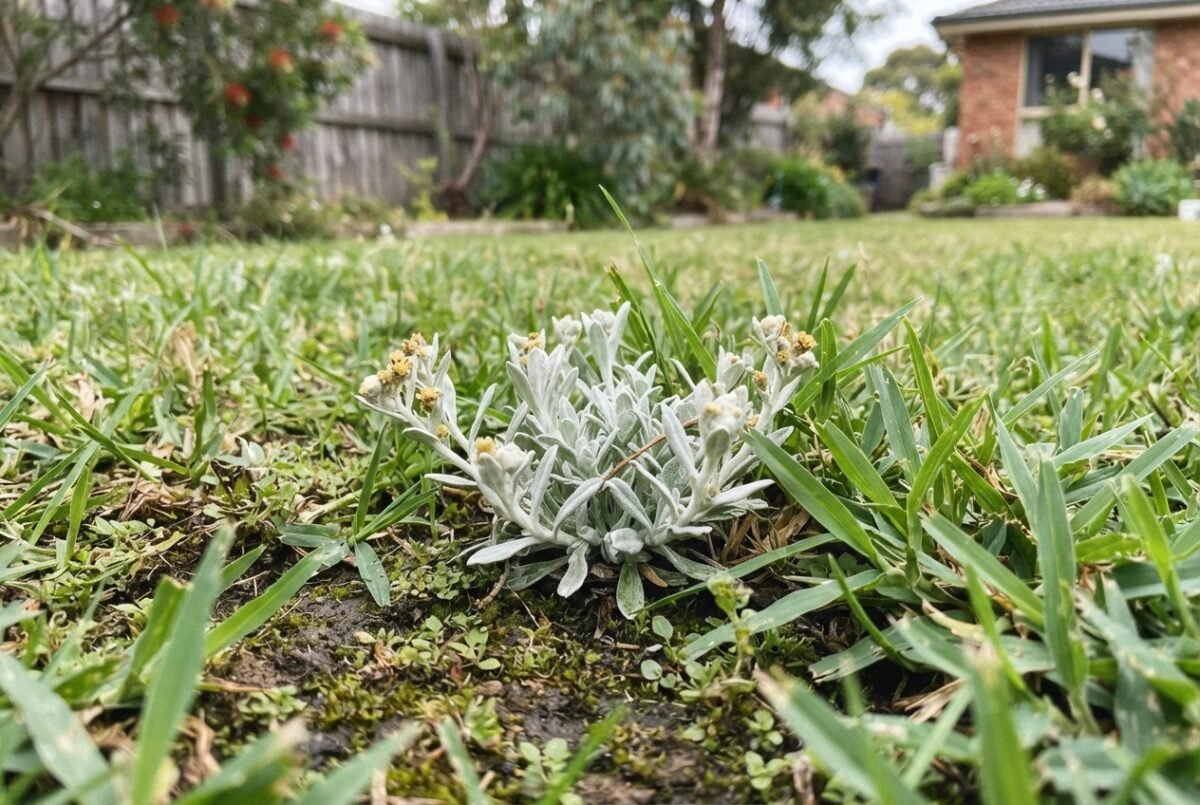
Key takeaway: Cudweed is a soft, woolly grey-green rosette weed in the Gamochaeta group that spreads through autumn and winter before bolting upright in spring. A broadleaf herbicide combining clopyralid, diflufenican and MCPA controls it at a label rate of 50 mL in 2 to 5 L of water per 100 m², though some buffalo varieties need a small test patch first.
Cudweed is the soft, silvery-grey patch that turns up in a tired lawn through the cooler months, flat to the ground and easy to walk past until it has spread right across a bare strip. It belongs to the daisy family, Asteraceae, and in Australian turf the culprit is almost always a species of Gamochaeta, though a couple of close relatives share the common name. The woolly, cottony hair covering its leaves is the feature that gives it away. No other common lawn weed feels quite like it. Spot it early, confirm the identification, and a broadleaf spray applied at the right rate for your grass type will clear it without much fuss.
Safety First: Check the Label Before You Spray
Any product you use on cudweed is only as safe as its current APVMA-approved label. In Australia that label carries legal force, so it is the actual instruction, not a disclaimer sitting next to the real advice. Registrations and formulations change over time, so check the product is still registered and read the rate for your situation before you mix anything. If you are not certain which grass you have, confirm it first. A rate that sits fine on couch can still mark a buffalo lawn, and the label is where that difference is spelled out, not the bottle’s front label.
What Is Cudweed? The Woolly Grey Weed Hiding in Your Turf
Cudweed is the common name for several low, grey-woolly weeds in the daisy family, Asteraceae. In Australian lawns the main offenders sit in the genus Gamochaeta, chiefly Gamochaeta coarctata and Gamochaeta americana, with Jersey cudweed (Pseudognaphalium luteoalbum) and Japanese cudweed (Euchiton sphaericus) turning up less often under the same common name. The Royal Botanic Gardens Victoria describes the genus as herbs with eglandular cottony hairs and leaves that are sometimes rosetted at the base, which is exactly the texture you feel running a hand over a cudweed patch. None of the Gamochaeta species are native here. They arrived from the Americas and have naturalised across lawns and disturbed ground in every state.
Cudweed vs Catsear, Dandelion and Bindii
Cudweed gets lumped in with every other low broadleaf weed on sight, but the woolly leaf settles the question fast. Nothing else common in an Australian lawn carries that same felted, grey-green coating.
| Feature | Cudweed | Catsear / Dandelion | Bindii |
|---|---|---|---|
| Leaf surface | Grey-green, covered in fine woolly (cottony) hairs | Green, hairy or smooth, no woolly coating | Bright green, finely divided, almost fern-like |
| Rosette shape | Flat, low rosette hugging the ground | Flat rosette with broader, lobed leaves | Low, spreading rosette of feathery leaflets |
| Flower / seed head | Small tan or cream flower heads on an upright stem in spring | Bright yellow, dandelion-style flower on a single or forked stalk | Tiny white flower, followed by the sharp seed burr |
| Height at maturity | Up to about 50 cm once it bolts | 10 to 30 cm | Stays under 10 cm |
- Soft, felt-like grey leaf, low rosette: that’s cudweed.
- Bright green rosette with a single yellow flower on a hollow stalk: that’s dandelion, not cudweed.
- Hairy but not woolly, with branching flower stalks: that’s catsear.
- Finely divided, fern-like leaflets with a spiky seed case forming later: that’s bindii, and it runs on its own treatment window.
When Cudweed Spreads in an Australian Lawn
Cudweed behaves like most cool-season broadleaf weeds in a warm-season lawn. The Brisbane City Council weeds guide notes that it overwinters as a small basal rosette, then usually sends up an upright flowering stem once spring arrives. That means the weed is already established by the time you spot it in a thin winter lawn. A lawn mowed too short or under-fed through autumn hands it exactly the open ground it needs.
Seed set follows in spring, so late winter, before it flowers, is the best treatment window for most of the country. In the warmer parts of coastal Queensland and northern New South Wales it can turn up earlier, tracking the first proper cool snap. Further south, in Victoria and Tasmania, it tends to hold off until deeper into autumn before it takes hold.
How to Get Rid of Cudweed
- Confirm it’s cudweed, not a lookalike. Run the table above before you buy anything. Bindii, catsear and dandelion all call for a different approach or timing.
- Thicken the lawn first if you can. Cudweed germinates in the bare, thin patches a warm-season lawn leaves behind over autumn. A denser sward through spring and summer gives it less room to establish the following year.
- Choose a broadleaf herbicide labelled for cudweed. Products combining clopyralid, diflufenican and MCPA are registered in Australia to control cudweed, listed on the label under its older name, Gnaphalium spp., alongside bindii, clover and creeping oxalis. Bow & Arrow Herbicide (APVMA approval 64580/125186) is one such product, used at 50 mL in 2 to 5 L of water per 100 m², or 5 L in 200 to 500 L of water per hectare on larger areas.
- Check the label against your grass type before you spray. That same label warns that certain buffalo varieties, ST85 among them, can show more pronounced effects than couch, and recommends testing a small area before spraying the whole lawn. Kikuyu, carpet grass and Queensland Blue Couch may show brief, transient discolouration that grows out. Never assume a broadleaf spray is buffalo-safe just because the front of the bottle says so. The critical comments further down the label are where the real answer sits.
- Spray while the weed and the lawn are both actively growing. Cudweed takes up herbicide poorly once it has hardened off for winter or the turf is under drought stress, and label directions generally rule out spraying stressed or frosted turf. Complete weed death can take several weeks.
- Hold off mowing for a few days either side of spraying. Cutting too soon removes leaf area the herbicide needs to work through, and mowing right beforehand can flatten the rosette instead of letting it take up the spray properly.
Common Mistakes That Let Cudweed Come Back
- Spraying a dormant or drought-stressed lawn. The herbicide needs active growth to move through the plant, in the weed and the turf alike.
- Treating the spring flowering stem and stopping there. By then this season’s seed is close to set, and next autumn’s rosettes are already the real target.
- Assuming any bindii spray is buffalo-safe. Check the turf notes on the actual label rather than the marketing on the shelf.
- Mowing too low through winter. A scalped lawn opens the same bare, thin ground cudweed needs to germinate in the first place.
When to Call a Lawn Care Professional
A light cudweed patch is a straightforward DIY job. It’s worth calling in a lawn care contractor where the infestation covers most of the lawn, where you’re not confident identifying your turf variety before spraying a chemical product, or where cudweed keeps returning despite two or three correctly timed treatments, since that pattern usually points to an underlying thinning or compaction problem the spray alone won’t fix.
Frequently Asked Questions
What does cudweed look like in a lawn?
Cudweed forms a low, flat rosette of grey-green leaves covered in fine, cottony white hairs, giving it a soft, felted look and feel that no other common lawn weed has. It sends up a thin upright stem topped with small tan or cream flower heads once spring arrives.
Is cudweed the same as catsear or dandelion?
No. Cudweed is in the genus Gamochaeta and is identified by its woolly grey leaves, while catsear and dandelion are bright green, hairy or smooth, and flower with a distinct yellow dandelion-style bloom. They belong to different genera within the same daisy family and need to be told apart before you choose a treatment.
When does cudweed appear in an Australian lawn?
Cudweed germinates and forms its rosette through autumn and winter, then bolts upright and flowers in spring before setting seed. Treating it in late winter, before flowering, gives the best result in most parts of the country.
Is it safe to spray cudweed on a buffalo lawn?
Check the label first rather than assuming yes. Herbicides registered for cudweed that combine clopyralid, diflufenican and MCPA note that certain buffalo varieties can show more pronounced effects than couch, and recommend a small test patch before spraying the whole lawn.
Will mowing get rid of cudweed on its own?
No. Mowing keeps the flowering stem down and stops seed set, but the low rosette sits below the mower’s reach and survives regular cutting. It needs a targeted herbicide or hand removal to actually clear it.
Is cudweed a declared or noxious weed in Australia?
No. Cudweed is not a declared weed under state biosecurity legislation. It is treated as a common environmental and lawn weed, a nuisance for turf quality rather than a legally notifiable species.
Cudweed rarely turns up alone. If your lawn is patchy with bindii or clover as well, our guide to getting rid of bindii and clover covers the same herbicide groups in more depth, and where the low patches turn out to be a different bulb weed entirely, oxalis and soursob explains why that pair needs its own approach. For the wider picture on keeping broadleaf weeds off an Australian lawn, see our [INTERNAL LINK OPPORTUNITY: link to the “Lawn Weeds Australia” guide, not yet published], or head to the full weeds and feed hub for everything else this site covers on identifying and treating turf problems.
Sources
- Royal Botanic Gardens Victoria, VicFlora: Gamochaeta genus profile (checked 13 September 2026)
- Brisbane City Council, Cudweed weed profile (checked 13 September 2026)
- Bow & Arrow Herbicide, APVMA-approved product label, Approval No. 64580/125186 (checked 13 September 2026)
- Australian Pesticides and Veterinary Medicines Authority, Search registered chemical products and permits (checked 13 September 2026)
