

Key Takeaway: Most patchy lawns recover by dethatching, filling hollows under 2cm with a 50:50 sand-and-soil topdress (never more than 10mm per pass), and repairing bare patches with runners or plugs for buffalo grass or seed for couch and kikuyu, once the grass is actively growing again in spring.
A patchy lawn is almost always three separate problems wearing one name: dead or thin grass in bare spots, an uneven or bumpy surface, and sometimes buffalo grass that looks completely dead in patches. Whatever caused it, winter wear, grubs, dog urine [INTERNAL LINK OPPORTUNITY: link to “How to Fix and Prevent Dog Urine Damage on Your Lawn”, draft 1358, not yet published], disease or simple thin turf, work through the fix in the same order: rake out the dead material, level the low spots, then fill the bare patches with the method that actually suits your grass. Most Australian lawns fill back in within 6 to 10 weeks once repair work is done during active growth. If the whole lawn is overgrown, thin and tired rather than damaged in specific spots, our guide to reviving a neglected lawn covers that broader sequence instead.
If you’re using a lawn starter fertiliser, a wetting agent, or treating weeds while you repair, check the current APVMA-approved label before you buy or apply anything, and confirm it’s rated safe for your grass type. Buffalo in particular is damaged by several herbicides that are perfectly fine on couch. If the pack doesn’t make this clear, search the product by name on the APVMA’s public register before you spray.
What’s Actually Wrong With Your Lawn
A quick way to sort a normal winter-wear patch from something that needs a different fix first:
Our full diagnostic guide to brown patches goes into more detail on telling these apart by shape and speed of onset, and our dog urine and pet damage guide [INTERNAL LINK OPPORTUNITY: link to “Dog Urine & Pet Damage: An Australian Guide”, draft 1390, not yet published] covers prevention if that’s the cause here.| What you see | Likely cause | What to do |
|---|---|---|
| Small circular dead or yellow patches, often with a dark green ring around them | Dog urine | Flush the spot with water to dilute the nitrogen, then repair as below |
| Irregular dead patches that lift or pull up like loose carpet, spongy underfoot | Lawn grubs (African black beetle, lawn armyworm) | Check under the turf for grubs, treat if confirmed, then repair as below |
| Roughly circular patches, worse in humid weather, seem to appear overnight | Fungal disease (brown patch) | Ease off night watering and improve airflow before repairing |
| Dry, straw-coloured patches where water beads and runs off instead of soaking in | Localised dry patch (hydrophobic soil) | Wetting agent plus aeration, then follow the repair steps below |
| General thinning and bare ground with no clear pattern | Ordinary wear, thatch build-up, shade or foot traffic | Go straight to the repair steps below |
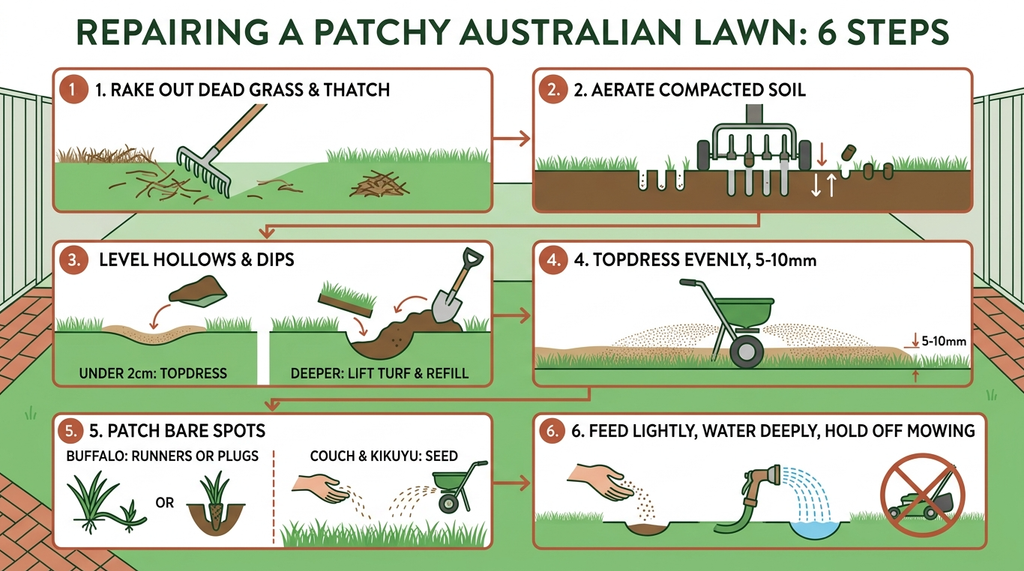
Rake, Aerate and Prepare the Area
- Work out why it happened. Use the table above: if it’s grubs or an active fungal outbreak, deal with that first, or you’ll be repairing the same patch twice.
- Rake out dead grass and thatch. Use a hard rake (or a dethatcher on a larger lawn) to pull out dead runners and built-up thatch until you can see soil in the bare patches. Don’t skip this: new grass, plugs or topdressing over a thatch mat just sits on top instead of taking root.
- Aerate if the soil is compacted. If water pools instead of soaking in, or a screwdriver won’t push into the soil easily, core-aerate the area before you level or patch it. See our full guide on how to aerate your lawn for the how and when.
Levelling Uneven or Bumpy Ground
Low spots and bumps are usually two different jobs, not one, and treating a deep dip like a shallow hollow is why levelling attempts often fail.
- Hollows under about 2cm deep: topdress them directly. Spread no more than 10mm of a 50:50 sand-and-soil mix (with a bit of compost) per pass, working it in with the back of a rake until the grass tips are still just visible. Deeper hollows need two passes a few weeks apart, not one thick layer.
- Dips deeper than roughly 5cm: topdressing alone won’t fix these. Cut and lift the turf, add and firm down extra soil underneath, then relay the turf so it sits flush with the surrounding lawn.
- Bumps and high spots: cut a cross or H-shape in the turf over the bump, fold back the flaps, shave off the excess soil underneath, then fold the turf back down and firm it in.
Levelling covers the whole area, but topdressing as its own ongoing lawn-care task (material choice, timing, frequency) is covered in full in our topdressing guide.
Filling Bare Patches: Buffalo, Couch and Kikuyu Aren’t the Same Job
This is where a lot of generic advice gets it wrong for Australian lawns, because it treats every grass as seedable.
- Buffalo grass (Sir Walter, Palmetto, Sapphire and most other lawn-grade buffalo cultivars sold in Australia) is a sterile hybrid. It doesn’t set viable seed, so a “buffalo grass seed” product is not a reliable way to fill a bare patch. Repair buffalo patches with runners or small turf plugs taken from a healthy part of the lawn (or bought as plugs), pressed into prepared soil and kept consistently moist. Buffalo spreads by surface stolons, so a light, regular feed and consistent watering will also encourage the surrounding lawn to run into the bare patch on its own over a few weeks.
- Common couch can genuinely be overseeded from seed, and it’s often the fastest way to fill a bare patch once the soil stays warm. Many of the named couch cultivars sold as instant turf, though, are hybrids and are vegetative-only like buffalo, so check with your turf supplier before assuming seed will work on a named variety.
- Kikuyu is usually repaired the same way as couch: seed is available and workable on common kikuyu, but confirm with your supplier if you’re not sure which strain you have.
Feed, Water and Wait
Once the area is levelled and patched, a light application of a lawn starter fertiliser and deep, less-frequent watering (rather than a quick sprinkle every day) gives new runners, plugs or seedlings the best start. See our guide on the best time to water your lawn and how often for the detail on timing and frequency, since it’s the same principle whether you’re watering an established lawn or a freshly repaired patch.
Hold off mowing until the new growth is clearly established and has a few centimetres of height, then take the first cut high rather than dropping straight back to your normal mowing height.
Common Mistakes
- Buying “buffalo grass seed” to fix a bare patch in a named buffalo lawn: it won’t establish reliably on a sterile hybrid cultivar.
- Topdressing more than about 10–12mm in one pass, which smothers the grass instead of helping it.
- Repairing or patching before the grass is actively growing again, since warm-season lawns just sit dormant until the soil warms up properly in spring.
- Treating every dead patch as a fertiliser problem without checking for grubs or fungal disease first.
- Watering little and often instead of deeply and less often, which keeps new roots shallow and slows recovery.
When to Call a Pro
- Dead or bare ground covering more than roughly 30 to 40% of the lawn: at that point a full renovation or relay is usually faster and cheaper than patch repair.
- A confirmed grub or fungal outbreak that keeps spreading despite treatment.
- Uneven ground caused by a drainage problem rather than cosmetic bumps, which needs grading, not topdressing.
When to Do This Repair
Timing matters more than technique here: the same repair done at the wrong time of year just sits and waits.
- Warm-season lawns (buffalo, couch and kikuyu, which cover most of Australia): wait until the grass is visibly, actively growing again, generally once night-time temperatures are reliably staying warmer through mid-to-late spring. Patching or topdressing too early, while the grass is still dormant from winter, means the repair sits doing nothing until the warm-up properly arrives.
- Cool-season lawns (fescue and ryegrass, realistically Tasmania, Victoria, the ACT and the highlands): these are actively growing through the cooler months, so early autumn or early spring both work, provided you avoid patching right before summer heat stress sets in.
- Climate zone matters as much as the calendar month: tropical Darwin and Cairns rarely see true dormancy, so repairs with regular feeding can often go ahead across most of the year. Temperate Sydney and Melbourne, and Mediterranean Perth, need to wait for genuine spring warmth. Cool zones follow the cool-season timing above.
Frequently Asked Questions
How long does it take a patchy lawn to recover after repair?
Most warm-season lawns fill back in within 6 to 10 weeks once repair work is done during active growth. Buffalo patches repaired with runners or plugs are usually the slowest, since they rely on lateral spread rather than germination, while couch and kikuyu seed can show visible green in as little as 1 to 2 weeks under warm, moist conditions.
Can I grow buffalo grass from seed to fix bare patches?
Not reliably. Named buffalo cultivars like Sir Walter, Palmetto and Sapphire are sterile hybrids that don’t set viable seed, so a bagged “buffalo grass seed” product won’t establish the same way it does on couch or kikuyu. Use runners or turf plugs instead, and encourage the surrounding lawn to spread into the patch with light, regular feeding and consistent watering.
How do I level a bumpy lawn without digging up the whole thing?
You don’t need to. Shallow hollows under about 2cm can be filled directly by topdressing, in passes of no more than 10mm at a time. Only genuinely deep dips, roughly 5cm or more, need the turf lifted so you can add soil underneath before relaying it.
Why does my lawn go patchy?
Often a mix of thin turf from shade or foot traffic, thatch build-up, and for warm-season lawns, winter dormancy and low light through the cooler months. Less often it’s an active problem like lawn grubs, fungal disease, dog urine or dry patch, which is why it’s worth checking the cause with the table above before you assume it’s just ordinary wear.
Should I fertilise or water first when repairing a damaged lawn?
Get the watering and soil contact right first. A newly patched or topdressed area needs consistent moisture to take root; fertilising a dry, freshly disturbed patch does little and can even stress it. Once it’s established and growing, a light starter feed supports the new growth.
